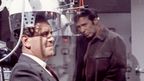
The series shifted the whole conception of TV sci-fi, showing how it could address complex themes. This was apparent from its very first episode, an adaptation of John Wyndham’s No Place Like Earth. Following a wanderer who leaves behind his lonely existence on Mars to try life on Venus, only to find its society is founded on slave labour, it was a not so subtle allegory about colonialism.
“Good science fiction is a way of saying something you can’t say in straightforward terms”, wrote Shubik in her 1975 book Play for Today: The Evolution of Television Drama. Brooker affirms this sentiment in regards to his own series. “I think that science-fiction is a way of talking about now and the world we live in today, but disguised as something fun. You can sneak stuff through, like chopping up vegetables to hide in your child’s meals. You can bend the rules of your reality into a funhouse mirror version of the issue you’re talking about.”
‘An unnerving glimpse into our present’
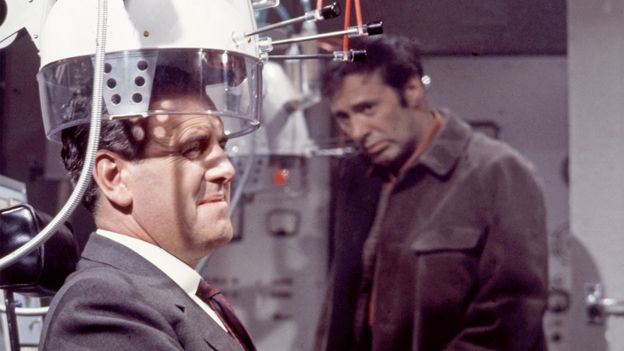
With Out of the Unknown produced mere years after the Berlin Crisis of 1961, when tensions between the Soviet Union and the West came to a head, resulting in the construction of the Berlin Wall, it’s unsurprising that the programme tapped particularly into paranoia over the Cold War. Both its second and third episodes, Alan Nourse’s The Counterfeit Man and David Campton’s Stranger in the Family, tackle the fear of infiltration by an enemy in disguise. Equally, the threat of nuclear war haunts the series. In Brunner’s Some Lapse of Time, a doctor treating an unusual man, assumed to be a homeless drunk, is disturbed to slowly realise that the patient may have travelled back from a future ravaged by a nuclear holocaust partly caused by a politician who is also staying in the hospital. Meanwhile an adaptation of Mordecai Roshwald’s novel Level 7 by JB Priestley follows an identity-erased soldier working deep in a bunker in which the response to a nuclear attack is conducted. Humanity doesn’t last long.
However, where Out of the Unknown really came into its own was in dealing with the effects of personal technology upon society. This is also where its fingerprints are detectable on Black Mirror. In one episode, Asimov’s The Dead Past, a kind of invasive, time-bending memory player – in which any event can be called upon and watched on screen – is eventually unleashed, prefiguring social-media addiction. It inevitably creates a society glued to screens via nostalgia as well as in a constant state of surveillance. Perhaps the most astonishing episode of the whole run, The Machine Stops, based on a short story by EM Forster, equally feels like an unnerving glimpse into our present. The drama follows a society that lives almost entirely closed off from one another except for communication via screens within a vast machine. The story, and in particular this adaptation by Clive Donner and Kenneth Cavander, feels like a perfect prophesy of the internet age.